


🏁S.M.A.S.H Driver Spotlight: Daryl Griffin, Old School and Built Not to Quit
- SMASH

- May 24
- 10 min read
By S.M.A.S.H — May 24, 2026
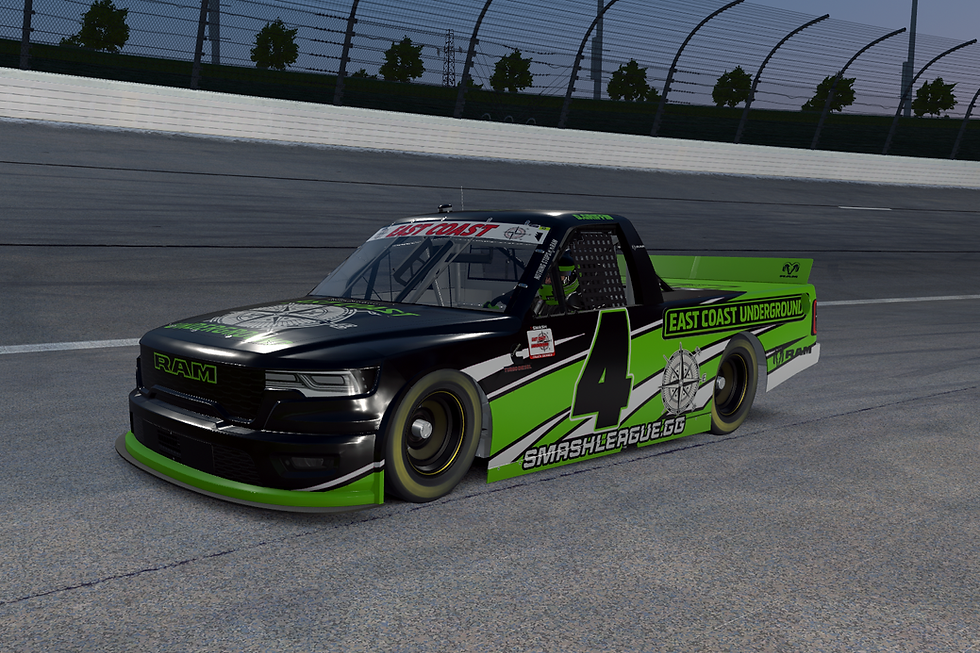
Some drivers find sim racing and never really leave it.
Others step away, live life, handle responsibilities, and eventually find their way back because the love for racing never went away.
Daryl Griffin fits that second group.
The driver of the #4 is not only a competitor inside S.M.A.S.H, but also the league owner and one of the people responsible for building the foundation behind it. His story goes back far beyond modern iRacing, back to the early days of sim racing, when the graphics were simpler, the tools were limited, but the passion for competition was already there.
When asked how long he has been sim racing, Daryl did not point to a recent start.
“NASCAR Racing 2, 1996.”
That answer says a lot.
Daryl’s connection to sim racing goes back decades. His style, his expectations, and his approach to league racing all come from that old-school foundation. He believes in finishing races, respecting the people around him, and building something that lasts longer than one good night on track.
When asked how he would describe his driving style, Daryl kept it simple.
“Old school.”
That answer fits.
Background
Name: Daryl Griffin
Number: #4
Sim Racing Roots: NASCAR Racing 2, 1996
iRacing Experience: 15 years
Real-Life Job: High-Voltage Lineman
Daryl’s path into iRacing started after years of already being around sim racing. Long before S.M.A.S.H, long before league websites, broadcast partners, driver pages, and modern race control systems, he was already turning laps in racing sims.
When asked how he got into iRacing, his answer was direct.
“I got into iRacing after NR2003 started phasing out.”
That experience gives Daryl a long view of the sim racing world. He has seen the cars change, the tracks change, the competition change, and the expectations around league racing change.
But his reason for starting S.M.A.S.H was never about trying to copy what everyone else was doing.
It came from wanting to build something for a specific kind of racer.
“I started S.M.A.S.H for the working man that wanted to race in a league group during the weekend, or when life would allow it.”
That is the foundation of S.M.A.S.H.
It was built for drivers with jobs, families, responsibilities, and real lives outside the sim. It was built for people who still love racing, still want structure, and still want competition, but cannot treat league racing like a second full-time job.
Daryl wanted S.M.A.S.H to be organized, professional, and competitive, but also realistic for the people it was built around.
The Approach
Daryl’s approach behind the wheel is built around one thing above all else.
He keeps going.
When asked for his biggest strength as a driver, he did not talk about raw speed, qualifying pace, or flashy moves.
“I don’t quit.”
That answer matches the driver and the person.
In racing, every driver has nights where the truck or car does not feel right. Every driver has races where the pace is not there, the track is difficult, or the result starts slipping away. The easiest thing to do in those moments is check out mentally or give up on the race.
Daryl does not see it that way.
For him, the race is not over until it is over. That mindset comes from more than sim racing. It comes from life, work, and the kind of responsibility that does not allow a person to quit just because something gets hard.
But he is also honest about the areas where he is still working.
“Being out of sim racing for over 10 years has been a challenge. I’ve had to relearn the newer cars and the way some of the tracks have changed after being repaved.”
That is a real answer.
Sim racing does not stand still. Cars change. Tire models change. Tracks get updated. Banking changes. The way drivers attack a race today is not always the same as it was years ago.
For Daryl, Season 1 has been about learning, adjusting, and getting better every week.
He is not hiding from that challenge.
He is working through it.
Tracks That Fit the Style
Daryl’s favorite type of track says a lot about the kind of driver he is.
He did not name one specific track. Instead, he described the kind of racing he enjoys most.
“Any track that you can’t hold the truck or car wide open and you have to manage the tires.”
That answer fits the old-school label.
Daryl likes tracks where the driver still matters. Tracks where a driver has to lift. Tracks where tire management matters. Tracks where long-run discipline is just as important as short-run speed.
Those tracks reward patience, rhythm, throttle control, and the ability to think beyond one fast lap.
For Daryl, that is real racing.
The toughest track for him so far in Season 1 has been Charlotte.
“Season 1 so far, Charlotte.”
Charlotte can look simple from the outside, but it can expose a driver quickly. It asks for speed, confidence, rhythm, and discipline. For a driver relearning modern cars and modern track behavior, Charlotte can be a serious test.
Daryl sees it as part of the process.
Another track to learn.
Another challenge to improve from.
Career Highlights
Every driver has a moment that stays with them.
For Daryl, that moment came in one of iRacing’s biggest events.
“In 2011, I finished 3rd in the iRacing Daytona 500.”
That is not a small accomplishment.
Daytona is unpredictable. It takes patience, awareness, drafting skill, and the ability to survive long enough to be in position when the race comes down to the end.
A third-place finish in the iRacing Daytona 500 is the kind of result that sticks with a driver.
For Daryl, it remains one of his most memorable moments in sim racing.
Not because it was easy.
Because it meant something.
Life Outside the Car
Outside of sim racing, Daryl’s life is built around family, work, and the things he enjoys when he gets time away from responsibility.
When asked what he does outside of racing, his answer was simple and honest.
“I spend time with my wife and family. I enjoy going to watch local short track racing, shooting guns, and relaxing on my days off.”
That answer gives a clear picture of who Daryl is.
Racing is a major part of his life, but it is not the only thing that matters. Family comes first. Real life comes first. When the PC turns off, there is still a world outside the sim that matters more than any finish, points battle, or on-track disagreement.
His real-life job also fits the working-man identity behind S.M.A.S.H.
“I am a High-Voltage Lineman.”
That kind of work takes focus, toughness, responsibility, and the ability to handle pressure. Those traits carry over into the way Daryl approaches both racing and running the league.
His hobbies outside of sim racing are also tied closely to who he is.
“Shooting guns, watching local racing, and building the S.M.A.S.H League.”
Even away from the driver’s seat, racing is still part of the picture.
Mindset
When asked what real race car he would want to drive, Daryl did not go straight to a Cup car or something unrealistic.
He picked a car that fits his personality.
“Super Late Model.”
That answer makes sense.
Super Late Models represent short-track toughness, driver control, and old-school racing. They are raw, demanding, and built for drivers who want to feel the car underneath them.
Daryl also had a clear answer when asked if there is a driver he models his style after.
“Clay Rogers.”
That answer says something about the kind of racing Daryl respects.
Clay Rogers built a reputation around short-track skill, toughness, and racecraft. That kind of style fits Daryl’s own approach: old school, patient, calculated, and built around respect for the race.
When asked whether he is aggressive or calculated, Daryl did not hesitate.
“Calculated.”
That answer fits everything else.
He is not trying to force every move. He is not trying to win the race on lap one. He would rather think through the situation, manage the race, and give himself a chance to be there at the end.
S.M.A.S.H Perspective
Daryl’s answer about what makes S.M.A.S.H different is one of the clearest explanations of what the league is supposed to be.
For him, S.M.A.S.H is not just a place to race.
It is a community with a purpose.
“What I hope makes it different is the league is not a copy-and-paste of any other league. We are not here to compete or try to model ourselves after any other leagues. We could carless how they are run.”
That statement matters.
S.M.A.S.H is not trying to pretend it is something it is not. It is not trying to chase another league’s identity. It is not trying to act like NASCAR is watching every lap or that a national opportunity is waiting after every race.
Daryl is honest about that.
“Let’s face it, NASCAR is not watching what we are doing, and it is unlikely that Dale Jr. will call one of us to come drive his race car.”
That honesty is part of the league’s identity.
S.M.A.S.H is not about chasing fantasy. It is about building a real group of racers who respect the time, effort, and commitment it takes to show up every week.
For Daryl, the league is not supposed to revolve around one or two fast drivers. It is supposed to be about the bond that forms between people who race together, talk together, and build respect over time.
That is why the league’s core values matter so much.
“If I could drive one point home, it would be that this league is about Integrity • Respect • Competition.”
Those three words are more than branding.
They are the standard.
Daryl believes S.M.A.S.H was built for drivers who want to be part of something bigger than themselves. Drivers who only show up to race, never interact in Discord, and never build relationships with the group are not the long-term core he wants the league to be built around.
His vision is clear.
“This league is here for the brotherhood and friendship we develop each week by racing and talking with each other.”
Over time, Daryl believes the lone-wolf drivers will phase themselves out, leaving behind a solid core of true league racers.
That is the S.M.A.S.H he is trying to build.
Competition Level
Daryl sees the competition inside S.M.A.S.H as strong, realistic, and healthy.
Not every driver is in the same place.
To him, that is a good thing.
“There are really fast drivers, drivers that are fast and run top 10 normally, and also drivers like myself that are learning and getting better with every lap.”
That is how a league grows.
You need the elite drivers who set the bar. You need the weekly top-10 drivers who make the field deep. You also need developing drivers who are learning, improving, and pushing themselves because the standard around them keeps getting higher.
Daryl believes all three groups matter.
“I believe it takes all three to make the league better.”
That is an important view from a league owner.
A strong league is not only about the fastest names at the front. It is about the full field. It is about every driver having a reason to show up, improve, and feel like they are part of the product.
The fast drivers set the standard.
The developing drivers chase it.
The league gets better when both sides respect the process.
Rivalries & Edge
When asked who the toughest driver is to race against, Daryl did not name one person.
He named a type of driver.
“Drivers that are hard to race against are the type that weed themselves out quickly. Fast but overaggressive, drivers that think it is all about them and do not respect the other drivers on the track or their time and effort.”
That answer is about more than racing.
It is about respect.
Daryl understands that speed alone does not make a good league racer. A driver can be fast and still be a problem. A driver can run up front and still hurt the product if they do not respect the people around them.
In S.M.A.S.H, racecraft matters.
Awareness matters.
Respect matters.
When it comes to drafting late in a race, Daryl does have one name he trusts.
“Darren Vale, #28.”
That says something different.
Drafting late in a race is about more than speed. It is about trust. It is about knowing the driver around you will hold a line, make smart decisions, and understand that both drivers are trying to get to the finish.
Daryl naming Darren Vale says a lot.
That is not just about pace.
That is about confidence.
Asked if he has ever rage quit a race, Daryl gave the kind of answer that matches everything else in this spotlight.
“Never. Just like in life, I refuse to give up.”
That is Daryl Griffin in one sentence.
No matter how frustrating the race gets, quitting is not the answer. Bad nights happen. Mistakes happen. Rough finishes happen.
But the race is not over until it is over.
That same mindset carries into how he looks at payback and apologies.
When asked if there is one driver he owes payback to, Daryl kept it clean.
“Nobody. After all, it is just a game — nothing more, nothing less.”
When asked if one driver owes him an apology, he gave the same kind of answer.
“Nobody. After it is over, I turn the PC off and get back to what matters most in life, and that is my family.”
That is perspective.
Racing gets intense. Tempers can flare. Drivers can disagree. But Daryl does not believe in carrying every moment with him after the race is over.
At the end of the night, the PC turns off.
Family comes first.
Goals for the Season
Daryl’s goals for the season are split between two roles.
The driver.
And the owner.
As a driver, the goal is simple.
“Get better.”
As an owner, the goal is bigger.
“Continue to improve the league and build off the lessons we learned in Season 1.”
That is the job now.
Every race, every issue, every success, and every mistake from Season 1 becomes part of the foundation for what comes next.
Daryl wants S.M.A.S.H to continue becoming a fun, professional league that drivers can enjoy in the future.
Not just for one season.
Not just for one series.
For the long haul.
Final Word
Daryl Griffin brings an old-school mindset to S.M.A.S.H.
He is a driver who refuses to quit, a league owner who believes in the working-man racer, and a builder who wants S.M.A.S.H to become more than just another place to turn laps.
His sim racing roots go back to NASCAR Racing 2 in 1996. His iRacing experience stretches back 15 years. His most memorable sim racing moment includes a third-place finish in the 2011 iRacing Daytona 500.
His toughest challenge now is relearning modern cars, modern tracks, and the rhythm of competition after more than a decade away from sim racing.
But Daryl is not backing away from that challenge.
He is learning.
He is building.
He is still racing.
And more than anything, he is trying to shape S.M.A.S.H into a league built around something that lasts longer than one race result.
Integrity.
Respect.
Competition.
For Daryl Griffin, that is the point of all of it.
The racing matters.
The people matter more.
And when the race is over, the PC turns off, and life goes back to what matters most, the goal remains the same for the next week:
Keep building.
Keep improving.
Keep showing up.


